
Back to Blogs
Industry
Digital Fabric Printing: How to Print Designs on Both Sides of Fabric
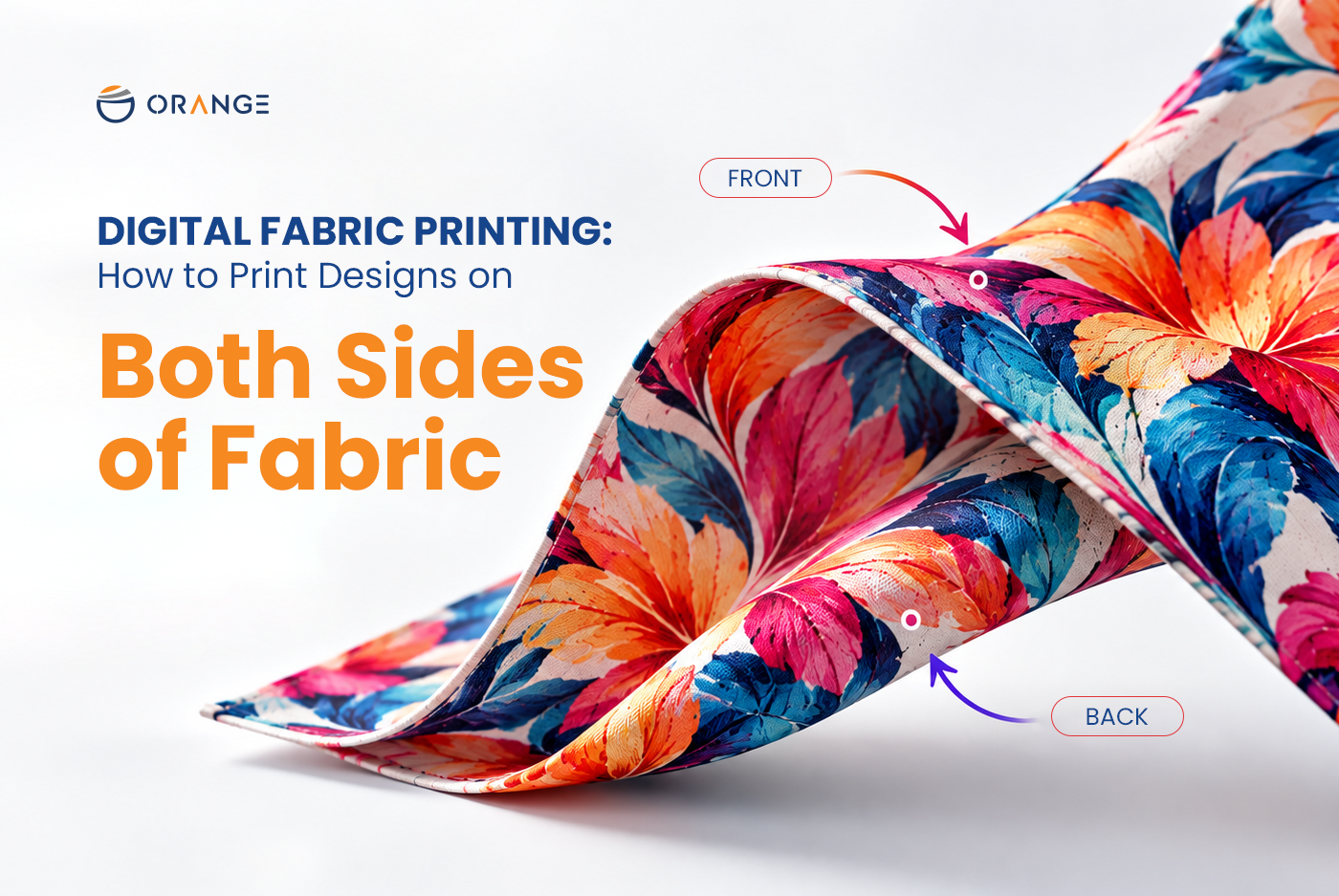
Fabric printing has moved well beyond basic single-sided designs. With growing demand for detailed patterns, customised textiles and high-quality finished fabrics, manufacturers are increasingly exploring double-sided fabric printing for applications where the design needs to be visible or replicated on both sides.
Orange O Tec
8 Oct 2026 • 5 min read
Traditional printing methods can make this process time-consuming because each side may need to be printed separately, aligned again and processed through additional steps.
Modern digital fabric printing technology offers a different approach. With the right digital textile printing machine, designs can be printed onto fabric with greater control over registration, colour and production workflow.
But how does printing on both sides actually work?
What Is Double-Sided Fabric Printing?
Double-sided fabric printing refers to printing designs, patterns or colour information on both sides of a fabric rather than printing only on one surface.
There are several ways manufacturers can achieve this:
- Printing one side and then processing the fabric again for the reverse side
- Printing the same design on both sides
- Printing different designs on each side
- Using a specialised digital printing system designed for synchronized double-sided printing
The last approach can reduce the need for separate passes and repeated handling, depending on the machine configuration and fabric application.
This becomes particularly useful when the reverse side of the fabric is an important part of the final product.
Why is Printing on Both Sides of Fabric Challenging?
Double-sided printing sounds like simply repeating the same process twice. In production, however, there are several factors to control.
1. Registration Between Both Sides
The design on the front and back needs to align correctly, particularly when the application involves detailed patterns, borders, or graphics. Even a small registration error can become visible on the finished fabric.
2. Fabric Handling
Fabric needs to move through the printing process consistently. Any movement, stretching, or misalignment can affect how the second side is printed.
3. Ink Penetration and Show-Through
Different fabrics absorb ink differently. When printing from one side, the amount of ink that penetrates through the fabric can affect the appearance of the reverse side. This makes fabric selection, ink compatibility, and print settings important parts of the process.
4. Production Time
Printing each side independently can mean additional handling, alignment, and machine time. For high-volume textile production, these extra steps can affect overall productivity.
5. Consistency
When the same or related designs are required on both sides, maintaining consistent colour and image reproduction becomes another consideration. This is where the capabilities of a modern digital fabric printing machine become important.
How Does Digital Double-Sided Fabric Printing Work?
A conventional approach involves printing one side first, repositioning or rewinding the fabric, and then printing the other side.
A specialised textile printing machine can take a more integrated approach.
In a synchronized double-sided printing system, print carriages or printheads work with coordinated image processing and fabric movement to reproduce the required design on both surfaces.
The basic workflow can be understood as:
Design file → Image processing → Synchronized printing → Drying → Finished double-sided fabric
The exact workflow depends on the fabric, ink, design, and machine configuration.
For manufacturers, the key advantage is not simply being able to print twice. It is being able to control the two-sided process as part of a single production workflow.
Can Different Designs Be Printed on Each Side?
Yes, depending on the digital fabric printing machine and its configuration. Double-sided digital printing can support applications where manufacturers need:
- The same design on both sides
- A mirrored design
- Different designs on each side
- Yarn-dye effect replication
- Detailed patterns requiring controlled registration
This creates possibilities beyond conventional two-sided fabric printing.
For example, a fabric could have a decorative design on one side and a complementary pattern on the other, depending on the end application's requirements.
Direct-to-Fabric Printing for Two-Sided Designs
Direct-to-fabric printing involves printing directly onto the textile rather than transferring the design from an intermediate medium.
It is widely used for applications where manufacturers need detailed digital designs, shorter runs, customisation, or design flexibility.
For double-sided applications, direct-to-fabric printing can provide greater control over how each surface is reproduced. However, the right direct-to-fabric printing machine needs to be selected based on the fabric construction, ink system, production volume, and desired finish.
Not every digital textile printer is designed for synchronized two-sided printing, so machine configuration matters.
What Should You Look for in a Digital Textile Printing Machine?
If double-sided printing is part of your production requirement, look beyond basic print speed. Consider:
Synchronized double-sided printing
The machine should be capable of coordinating the printing process across both sides of the fabric.
Printhead technology
Printhead configuration affects resolution, ink placement, and overall production performance.
Image processing
Onboard image processing can help manage how designs are reproduced during production.
Drying system
Efficient drying becomes especially important when both sides are being printed.
Fabric compatibility
The machine should be suitable for the fabric widths, constructions and applications you work with.
Production requirements
Consider your typical fabric width, print volume, design complexity and required output before selecting a fabric printing machine.
MAS Vertical: Double-Sided Digital Fabric Printing in One Pass
For manufacturers looking specifically at synchronized two-sided production, MAS Vertical is designed around this requirement.
The system uses a synchronized double-sided printing setup with dual-carriage Kyocera KJ4B 600 dpi printheads, allowing both sides of the fabric to be processed within the same printing workflow.
The machine supports fabric widths from 900 mm to 1850 mm and can be configured with up to 8 colours. Its system also incorporates onboard image processing and dual-zone drying.
One of the key capabilities is its approach to double-sided printing in a single pass, helping reduce the need for separate front-and-back printing operations. It also supports digital yarn-dye effect replication, opening up applications where manufacturers want the visual effect of yarn-dyed fabrics through digital printing.
The system is positioned for applications including apparel manufacturing, high-fashion and accessories, and technical textiles, where two-sided design reproduction and registration can be important.
For manufacturers evaluating a new digital textile printing machine, this makes MAS Vertical relevant when double-sided printing is a production requirement rather than an occasional requirement.
Applications of Double-Sided Digital Fabric Printing
Two-sided digital printing can be useful across several textile applications, including:
- Apparel: Fabrics where the reverse side contributes to the overall design
- High fashion: Detailed and customised fabrics with different visual treatments
- Accessories: Scarves, fashion accessories and other printed textiles
- Technical textiles: Applications requiring controlled printing across both surfaces
- Decorative textiles: Fabrics where both sides may be visible in the final application
As digital textile production continues to move toward shorter lead times and more customised designs, two-sided printing can add another layer of flexibility to textile manufacturing.
The Future of Digital Fabric Printing Is More Flexible
The role of digital printing in textiles is expanding from simply replacing conventional printing processes to enabling designs and production methods that are difficult to achieve through traditional workflows.
Double-sided fabric printing is one example.
With synchronized printing, improved image processing, specialised drying systems and modern printhead technology, manufacturers can approach two-sided fabric production with greater control and fewer process steps.
The right solution, however, depends on the fabric, application and production requirements. For manufacturers considering an upgrade, the important question is not simply “Can this machine print both sides?” but “How efficiently and consistently can it do so at the scale I need?”
That is where choosing the right digital fabric printing machine, ink system, and production configuration becomes critical.
Looking to explore double-sided digital fabric printing for your production line? Talk to us and understand how synchronized two-sided printing can fit into your textile production requirements.