
Back to Blogs
Industry
How Government Schemes Are Fuelling India's Digital Textile Printing Revolution?
India has always been a textile powerhouse. But for all the fabric produced, much of how it is printed hasn’t changed in decades. Rotary screens, water-intensive processes, and long setup times – while the rest of the world has already moved to digital textile printing machines that offer speed, precision, and a fraction of the environmental cost.
Orange O Tec
16 Sept 2026 • 5 min read
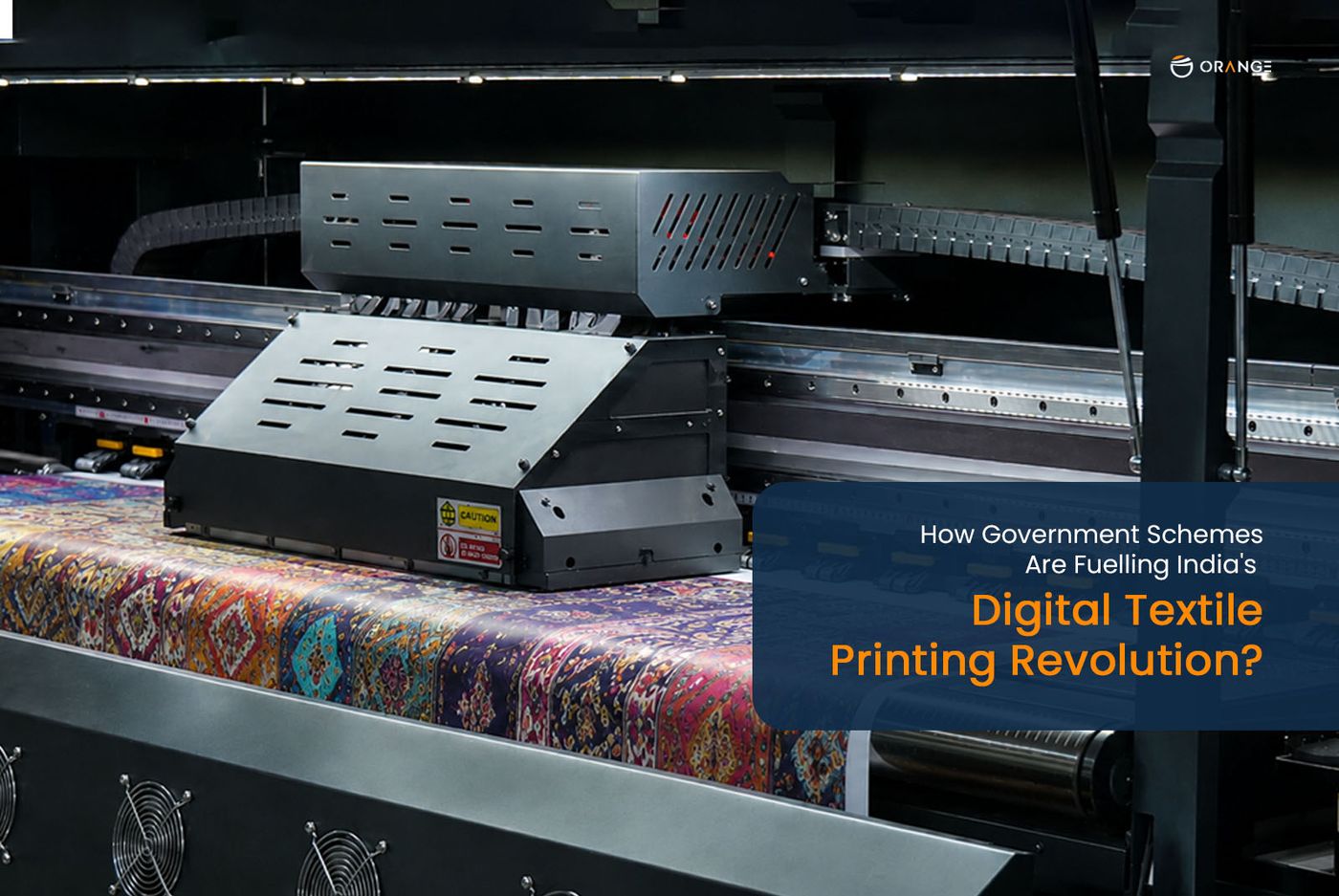
That gap is closing, and government policy is playing a bigger role than most manufacturers realize. A set of well-funded schemes is actively making it easier and more affordable for Indian textile businesses to upgrade to modern digital fabric printers.
Why Government Support Matters for Digital Textile Printing?
Countries like China, Turkey, Bangladesh, and Portugal have already made the shift. Their manufacturers have invested heavily in high-speed digital textile printers that can produce thousands of metres per day with near-zero sampling waste and significantly lower water usage. Their buyers, international fashion brands, home textile companies, sports apparel exporters, have come to expect these standards.
Digital textile printing offers a fundamentally different way of working. Instead of creating costly screens for each colour in a design, a digital fabric printer processes the design directly from a computer and prints it onto fabric in one go. This means:
- Sampling that used to take days can be done in hours
- Short runs of 50, 200, or 500 metres become economically viable
- Water consumption drops dramatically, by up to 90% compared to traditional screen printing
- Colour accuracy and repeatability improve significantly, reducing buyer rejections
For Indian manufacturers looking to grow their export business or serve fast-fashion domestic buyers, these advantages are not nice-to-have; they’re essential. The good news is that the Indian government understands this, and a set of well-structured schemes is now helping manufacturers make that transition.
PLI Scheme: Rewarding Manufacturers Who Invest in Technology
The Production Linked Incentive (PLI) Scheme for Textiles is one of the most significant policy moves India has made for the sector in recent years. The core idea is straightforward: the more you invest in modern manufacturing and the more you grow your production, the more you earn back in incentives. It’s designed to make large-scale investment in technology genuinely attractive, not just in theory, but on the balance sheet.
For the digital textile printing space, this is significant. Investing in a high-performance industrial textile printer or a full digital printing line with ink systems and workflow software requires serious capital. The PLI framework reduces the perceived risk of that investment by tying incentives to actual incremental production. Manufacturers who build out their digital printing capacity and grow their output are rewarded directly.
It also pushes manufacturers to think beyond just buying a machine. The scheme encourages investment in end-to-end production upgrades, which is exactly what modern digital textile printing requires: the right printer, the right ink, the right pre- and post-treatment setup, and the right team to operate it all.
PM MITRA Parks: Building Clusters for Digital Printing Growth
PM MITRA – Pradhan Mantri Mega Integrated Textile Regions and Apparel Parks, is a bold initiative to create seven world-class integrated textile manufacturing hubs across India, in states including Gujarat, Tamil Nadu, Karnataka, Uttar Pradesh, Madhya Pradesh, Maharashtra, and Telangana.
What makes PM MITRA different from most industrial park schemes is the level of integration it aims for. These aren’t just plots of land with a shed. The parks are designed to bring together spinning, weaving, processing, printing, and garmenting under one roof with shared infrastructure, plug-and-play utilities, and logistics support.
For digital textile printing businesses, this is a genuinely exciting development. Imagine a printing unit set up inside a PM MITRA park, surrounded by fabric suppliers, garmenting units, and export logistics with clean power, water treatment, and effluent management handled at the park level. That’s the kind of environment where a digital fabric printing machine can operate at its full potential. Fast sampling. Flexible short runs. On-time delivery to buyers.
It also aligns with global demand for sustainable production. Parks built with water recycling and zero-liquid-discharge infrastructure are exactly the kind of setting that international buyers, especially in Europe and North America, are increasingly requiring from their suppliers.
TUFS: Making the Economics of Upgrading Work
The Technology Upgradation Fund Scheme (TUFS) has been running in various forms for over two decades, and it remains one of the most practically useful tools available to textile manufacturers looking to modernise. The scheme provides capital subsidies and interest rate support for investments in new machinery and technology.
In plain terms: if you’re a manufacturer looking to invest in a new digital textile printing machine, TUFS can help reduce your upfront cost and lower your loan interest burden. That matters a lot, especially for mid-sized manufacturers and MSMEs who want to upgrade but are cautious about taking on large debt.
The transition from rotary or screen printing to digital is not just a machine purchase; it also involves changes in workflow, ink systems, and in some cases, factory layout. TUFS makes it easier to finance not just the printer itself, but the broader investment in modernising a production line. For manufacturers looking at a serious upgrade, say, moving from analogue screen printing to a high-speed industrial fabric printer, TUFS is often the financial bridge that makes it viable.
Skill Development: The Missing Piece in Digital Textile Printing Adoption
Here’s something manufacturers don’t always think about when they buy a digital textile printer: the machine is only as good as the team running it. Operating a modern digital fabric printing machine involves skills that are genuinely different from traditional printing, colour management, RIP software handling, printhead calibration, ink maintenance, and quality control at every stage.
This is where government skill development initiatives become critical. The Integrated Skill Development Scheme (ISDS) for textiles, along with programmes under the National Skill Development Corporation (NSDC), are creating frameworks to train workers in new textile technologies. As digital textile printing grows, there’s a clear opportunity to build these specific skills into the curriculum.
For manufacturers making the switch, investing in operator training isn’t optional; it’s the difference between running a machine at 60% efficiency and getting the full performance you paid for. Companies like Orange O Tec build hands-on training and ongoing technical support into their customer relationships precisely because the machine and the knowledge have to grow together.
Beyond the Schemes: What Actually Drives the Transition
Government support creates the conditions for change. But the actual transition depends on decisions made at the factory floor level. A few things consistently separate manufacturers who successfully make the shift from those who get stuck:
- Choosing the right machine for the right application. A sublimation textile printer works brilliantly for polyester and sportswear. A direct-to-fabric digital printer is what you need for cotton, silk, and natural blends. Getting this wrong is an expensive mistake.
- Ink quality is not a secondary decision. The ink you use determines colour vibrancy, wash fastness, fabric handle, and compliance with international eco-standards. OEKO-TEX® certified inks like those in the Syahi range are increasingly expected by global buyers, not just as a preference but as a requirement.
- Think ecosystem, not just machine. The manufacturers who scale fastest are those who build out a complete digital printing workflow – machine, ink, software, pre-treatment, and after-sales support, rather than piecing together components from different vendors without clear compatibility.
- Start with a clear production goal. How many metres per day do you need to print? What fabric types? What price point does your business model require? These questions should drive machine selection, not the other way around.
The schemes help with cost and financing. But none of that matters if the machine choice or the production setup isn’t right for the business.
Conclusion
India’s textile sector has every advantage it needs to lead the global digital printing shift: scale, design heritage, a massive domestic market, and now, meaningful government support. The PLI scheme, PM MITRA parks, TUFS financing, and skill development programmes collectively reduce the cost, risk, and complexity of making the move to digital.
What they can’t do is make the decision for you. That has to come from the business owner who looks at their production line, their buyer demands, and their growth ambitions and decides that the old way of printing is no longer good enough.
Because the future of Indian textiles isn’t woven, it’s digitally printed. And the manufacturers who move now will be the ones setting the pace for everyone else.
Ready to Make the Move to Digital Textile Printing?
Talk to our team about the right digital textile printer for your production needs, how government schemes apply to your investment, and what a complete digital printing setup looks like for your factory.