Textile Printing Machine: The Complete Buyer's Guide for India's Growing Textile Industry
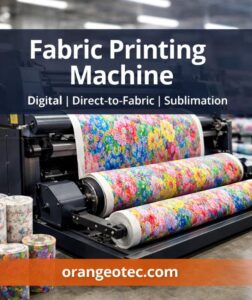
Is your textile printing machine holding your business back?
A textile printing machine is the heart of any fabric production operation. Get it right and you unlock speed, quality, flexibility, and profitability. Get it wrong and you’re dealing with downtime, poor print quality, unhappy buyers, and machines that can’t keep up with your orders.
India’s textile industry is at an inflection point. Traditional screen and rotary printing machines that defined production for decades are rapidly being replaced by digital textile printing machines that offer speed, versatility, and sustainability that older technologies cannot match. This guide covers everything you need to know about textile printing machines — types, technologies, applications, and how to make the right choice for your operation.
What Is a Textile Printing Machine?
A textile printing machine is industrial equipment used to apply colour and pattern onto woven, knitted, or nonwoven fabric substrates. The category spans a wide range of technologies — from traditional flat-bed and rotary screen printers to modern inkjet-based digital textile printers that have revolutionised what is possible in textile production.
For India’s manufacturers — from Surat’s polyester mills to Tirupur’s garment exporters — choosing the right textile printing machine is one of the most consequential business decisions you will make.
Traditional vs. Digital Textile Printing Machines
Traditional Textile Printing
Screen printing, rotary printing, and block printing have defined textile production for generations. However, they carry significant limitations:
- High screen/plate setup costs that make short runs uneconomical
- Minimum order requirements that limit customisation
- Slow turnaround from design to production
- High water and chemical consumption
- Limited colour complexity and gradient capability
Digital Textile Printing Machines
Digital textile printing machines use precision inkjet technology to print directly from digital files onto fabric. The advantages are substantial:
- No screens or plates required — zero setup cost per design
- Print any volume from 1 metre to 10,000+ metres
- Unlimited design complexity including gradients and photographic prints
- Faster time-to-market — hours instead of days
- Significantly lower water and chemical usage
- Single operator can run the entire process independently
Modern digital textile printing machines have eliminated the need for traditional plate making and repetitive colour registration — allowing one operator to manage the entire printing process independently.
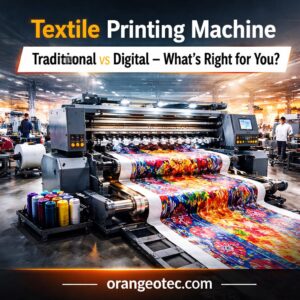
Key Types of Digital Textile Printing Machines
Direct-to-Fabric Printers
Compatible with cotton, silk, nylon, viscose, Lycra, denim, and wool — direct-to-fabric machines are the most versatile digital textile printing option. Orange O Tec’s Colorix and Homer series are engineered for Indian production conditions, offering high quality, reliable ink delivery, and the throughput that commercial manufacturers demand.
Sublimation Textile Printing Machines
Sublimation machines print onto transfer paper and heat-transfer onto polyester fabric. The result is vibrant, wash-resistant, seamless prints — ideal for sportswear, swimwear, fashion scarves, and polyester home textiles. Orange O Tec’s sublimation range delivers consistent colour reproduction at high speed.
High-Speed Industrial Textile Printing Machines
Orange O Tec’s Homer ‘Rocket’ — a hybrid single-pass digital textile printer — delivers up to 60,000 linear metres per day. This brings digital quality and flexibility to operations previously only served by rotary screen printing.
Choosing the Right Textile Printing Machine
Your Fabric Mix
- Cotton/natural fibres → Reactive ink, direct-to-fabric machine
- Polyester → Disperse ink, sublimation machine
- Mixed fibres → Pigment ink, direct-to-fabric machine
- Silk, wool → Acid ink, direct-to-fabric machine
Production Volume
Match machine throughput to your current and projected production volumes. Undersizing leads to bottlenecks. Oversizing ties up capital. Orange O Tec offers machines across a range of capacities to match different scales.
Ink Technology and Sustainability
India’s export buyers — particularly in Europe — increasingly demand sustainability credentials. Orange O Tec’s Green Edge Series pigment inks eliminate the steaming and washing stages of reactive inks, dramatically reducing water consumption and effluent — a significant advantage for export-oriented manufacturers.
Government Schemes to Know
Several government schemes support textile printing machine investment in India — including the Technology Upgradation Fund Scheme (TUFS) and the PM MITRA textile parks initiative. State-level subsidies are available in Gujarat, Tamil Nadu, and Rajasthan. Orange O Tec’s team can provide guidance on applicable schemes.
After-Sales Support
Orange O Tec operates from Surat — India’s textile capital — with a dedicated support and services team for all installed machines, genuine spare parts, and trained service engineers across India.
Frequently Asked Questions
Q1. What is the most popular textile printing machine in India right now?
Digital textile printing machines — particularly direct-to-fabric and sublimation printers — have seen the fastest adoption across India’s textile hubs. Orange O Tec’s Colorix and Homer series are among the most widely used by manufacturers upgrading from traditional printing methods.
Q2. What is the difference between a textile printing machine and a fabric printing machine?
The terms are used interchangeably. Textile printing machine refers to the broader category of equipment used in textile production. Fabric printing machine typically refers to machines printing directly onto finished fabric. In digital printing, both terms describe the same category of inkjet-based digital printers.
Q3. How quickly can a digital textile printing machine be set up?
Most machines can be operational within a few days of installation. Orange O Tec provides installation, commissioning, and operator training as part of delivery. Full production efficiency is typically achieved after initial calibration and training.
Q4. Can one machine print on both cotton and polyester?
Yes — with the right ink system. Direct-to-fabric machines with pigment ink are compatible with both. For maximum polyester performance, sublimation delivers superior wash-fastness. Orange O Tec can configure the right machine and ink combination for your substrate mix.
Q5. What government support is available for textile printing machine investment in India?
TUFS (Technology Upgradation Fund Scheme), PM MITRA parks, and state subsidies in Gujarat, Tamil Nadu, and Rajasthan are key schemes. Orange O Tec’s team can advise on the schemes applicable to your investment.
Conclusion: Your Textile Printing Machine Is Your Most Important Asset
The right textile printing machine determines how fast you respond to trends, how efficiently you use resources, and how competitive your pricing is. The shift to digital is not a future trend — it is happening now, across every major textile cluster in India.
Orange O Tec delivers advanced digital textile printing solutions with high-speed printers, eco-friendly inks, and trusted service — driving innovation and sustainability across India’s textile industry.
📞 info@orangeotec.com | +91 7486032990