
Back to Blogs
Industry
How Digital Inkjet Printers Are Transforming Book and Magazine Production
Picture a publisher who orders 2,000 copies of a reference title and sells 300 in the first year. The other 1,700 sit in a warehouse, holding cash hostage. An inkjet printing machine goes after exactly this problem. It prints straight from a PDF with no plates, so a reprint of 100 or 300 copies becomes routine work rather than a favour.
Orange O Tec
31 Oct 2026 • 5 min read
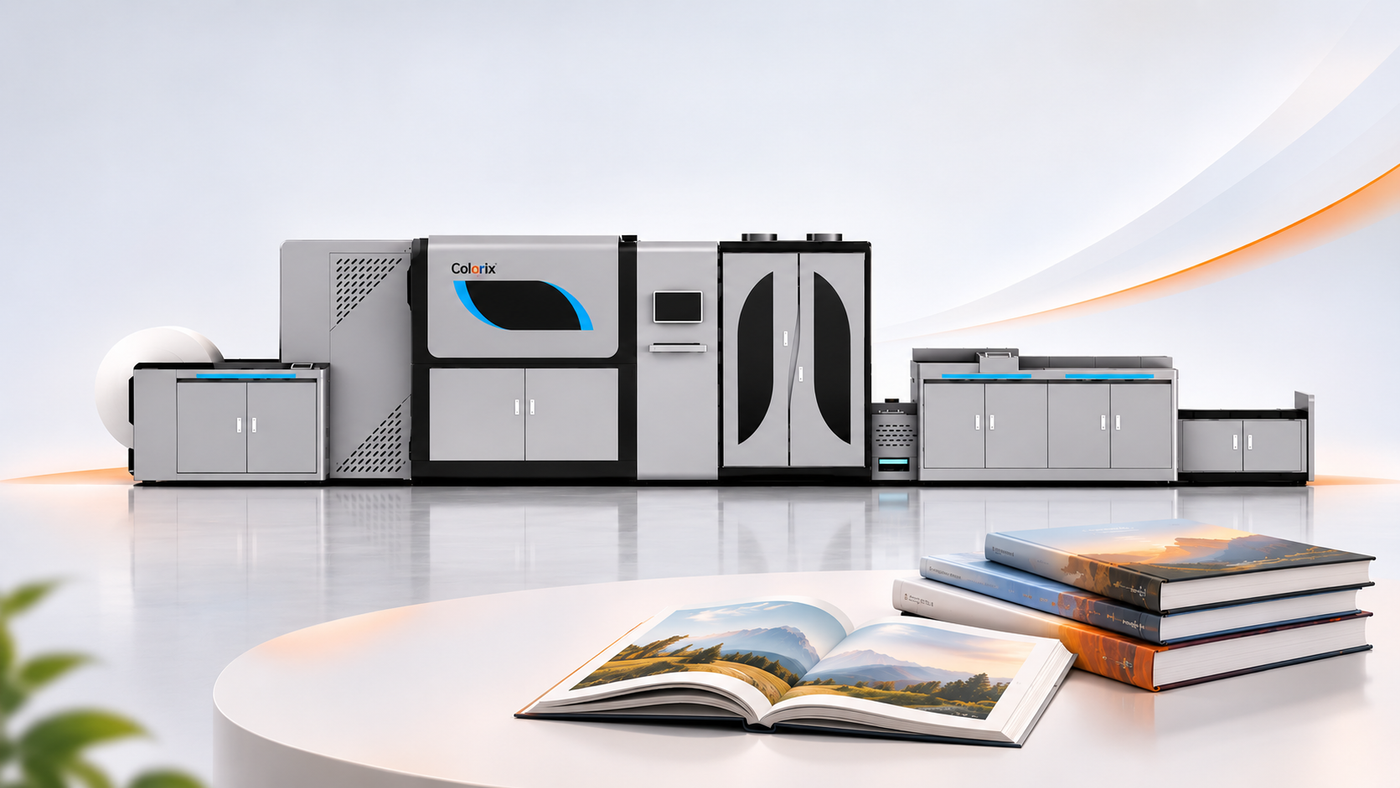
This blog post covers the changes book and magazine printers face when they add digital inkjet printing. It also looks at where offset still wins, and what to check on paper and finishing before you invest.
What changes when the plates disappear?
Offset needs a plate for every colour on every job, followed by press setup while the operator adjusts ink levels and aligns the sheets. On a long run, that setup cost gets divided across so many copies that nobody notices it, but on a 200-copy reprint it's most of the bill.
Digital inkjet printing eliminates the need for plates and requires minimal setup time. The press takes a print-ready file, and each page can differ from the one before it. That second part is easy to overlook. One run can carry a student's name on every workbook, or a unique QR code on each copy. It can also switch from a school-board edition to a regional-language edition of the same title, back to back, without stopping the press.
Where does short run book printing beat offset?
Offset works well for the first print run, when demand is predictable, and you can commit to a larger quantity. Digital inkjet printing makes more sense when demand is uncertain, when a title needs an early reprint, or when only a few copies are selling each month.
This becomes particularly useful for publishers managing a large catalogue of titles. Instead of printing thousands of copies upfront and tying up money in inventory, they can print smaller quantities as orders come in. If a title needs another batch, it can go back into production without the delays and setup involved in offset printing.
That's where print-on-demand becomes practical. Inkjet book printing allows publishers to keep slow-selling titles available without committing to large print runs.
There's also a cost that often gets overlooked: unsold stock. Printing closer to actual demand helps reduce excess inventory, storage requirements and the risk of books becoming outdated before they're sold.
How fast is high-speed inkjet printing, in books per hour?
VividPress-E is a single-pass piezoelectric inkjet press. It prints CMYK on both faces of the web at once, at up to 100 metres a minute and 1200 × 600 dpi, with front-to-back registration of ±0.5 mm. It comes in two widths: the 440C (429 mm print width) and the 6600 (645 mm).
Metres per minute doesn't mean much when you sell books. So here's the arithmetic. Take a 240-page A5 book with 3 mm bleed, so each page is 154 × 216 mm, laid with a long edge running along the web. The 440C fits two pages across and the 6600 fits four, and every stretch of web carries pages on both sides. At full speed, that works out to about 460 books an hour on the 440C and about 920 on the 6600. Over an eight-hour shift, that's roughly 3,700 and 7,400 books.
That's our own back-of-envelope maths from the published specification, not a measured result. Treat it as a ceiling. It ignores web joins, reel changes and test prints, and it says nothing about what happens after the press. [ADD: books per hour measured on a demo or test unit]
What comes after the press usually decides the real output. A press making 900 books an hour is wasted if the folder and binder manage 400. VividPress-E can rewind the printed web onto a roll for separate finishing (roll-to-roll). With an optional inline sheeter it cuts flat sheets (roll-to-sheet), and it can also feed a folding line that delivers signatures (roll-to-fold). Before you compare presses, list every machine you already own after the press and find the slowest one. That's your real speed.
Simple, but it changes the buying conversation.
Paper is where inkjet jobs go wrong
The press uses water-based pigment ink, dried by infrared, and runs paper from 45 to 160 gsm. That covers most book and magazine work, but not every paper in your store. Production inkjet printing is fussier about stock than offset.
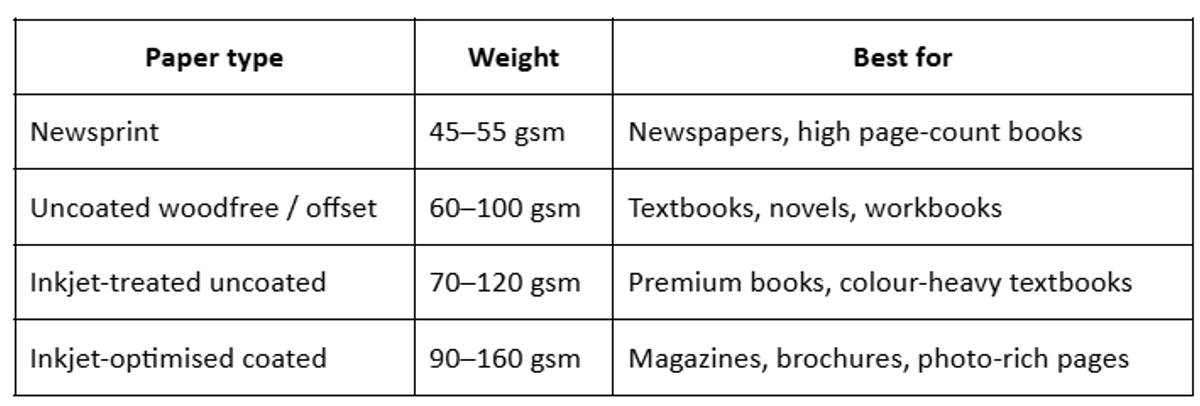
standard coated offset paper. It's made for offset inks and may not absorb water-based inkjet ink properly, so the glossy stock that looks perfect on your offset press can look wrong here. Test your actual stock on the press before committing to a large order.
Text-heavy titles like workbooks and novels sit comfortably on uncoated woodfree. If a book has colour plates, step up to inkjet-treated uncoated.
Magazines are a different job from books
Books are mostly text, and magazines are mostly images. That pushes you towards inkjet-optimised coated stock, and it changes the finishing too: saddle stitching suits slim periodicals, perfect binding suits thicker ones.
There's an honest limit here. Core Print describes offset as still the gold standard for full-colour interiors with heavy ink coverage, and says digital may need adjustment for saturation-heavy designs. So a national weekly with 100,000 copies stays an offset job. Digital magazine printing makes more sense for small-circulation titles and regional editions. It also works for a test issue before you commit to an offset run. Print a sample of your hardest cover or photo spread first.
Before you buy a production inkjet press
- Your run-length mix. Pull last year's job list and count how many jobs were under 1,000 copies.
- Your stocks. Test the ones you actually buy, not only the demo stock.
- Your finishing line. Find the slowest machine after the press.
- Service and consumables. Ask who responds, how fast, and what a printed page costs once ink and printheads are counted.
VividPress-E is our answer for printers and publishers working in this range: single-pass duplex output in two widths, with finishing planned around the equipment you already run.
FAQs
What is an inkjet printing machine for books?
It's a press that prints pages straight from a digital file using inkjet printheads, with no plates. VividPress-E prints both sides of a roll in one pass, which suits short runs and reprints.
Is digital printing for books cheaper than offset?
Under roughly 1,000 copies, usually yes. Above 1,500, offset normally takes over, and in the grey zone between the two you should ask both a digital printer and an offset printer for a quote.
Can an inkjet printer handle magazines?
Yes, on inkjet-optimised coated paper from 90 to 160 gsm, with saddle stitch or perfect binding. For very heavy ink coverage, run a sample first.
What does print on demand mean for books?
Printing copies as orders arrive instead of stocking a large print run. With no plates, even a handful of copies is practical, which suits backlist titles.
Does cost per copy change between 100 and 1,000 copies?
On the press itself, it stays roughly flat, because there are no plates to spread across the run. Setup for files and finishing still costs something. Ask for a job-level quote.