
Back to Blogs
Industry
Duplex Printing vs Single-Sided Printing: Key Differences
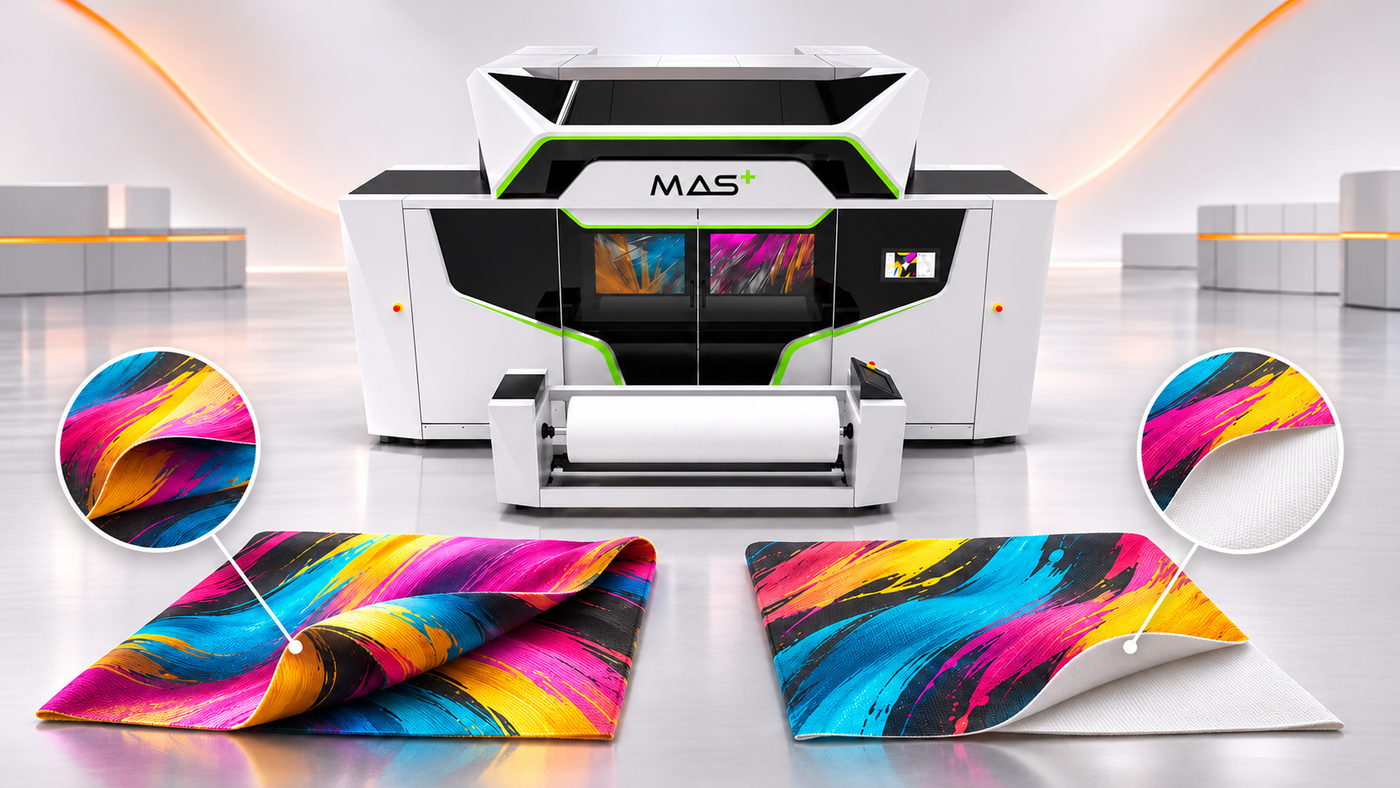
Hold a printed georgette dupatta up to a window, and you'll notice the back often looks faded compared to the front. This happens because single-sided printing allows ink to pass through the fabric, creating a softer image on the reverse. Duplex printing works differently by printing a clear, sharp design on both sides, ensuring the fabric looks good from every angle.
Orange O Tec
3 Nov 2026 • 5 min read
What does duplex printing actually mean?
The term comes from office printing (it's the setting most people first meet in a print dialog). A printer that prints one side of a sheet is "simplex", and one that prints both sides is "duplex". On textiles, the duplex printing meaning stays the same. Both faces get printed deliberately, and each one needs its own colour settings and its own registration against the other side of the cloth.
Fabric just makes it harder. A sheet of A4 stays flat and keeps its size, while a roll of viscose stretches under tension, shrinks slightly as it dries and lets ink travel through its weave. So on fabric, double sided printing really means controlling two images that have to line up on a material that won't sit still.
Print-through isn't duplex. If colour bleeds to the back of a thin chiffon, you've still done single sided printing.
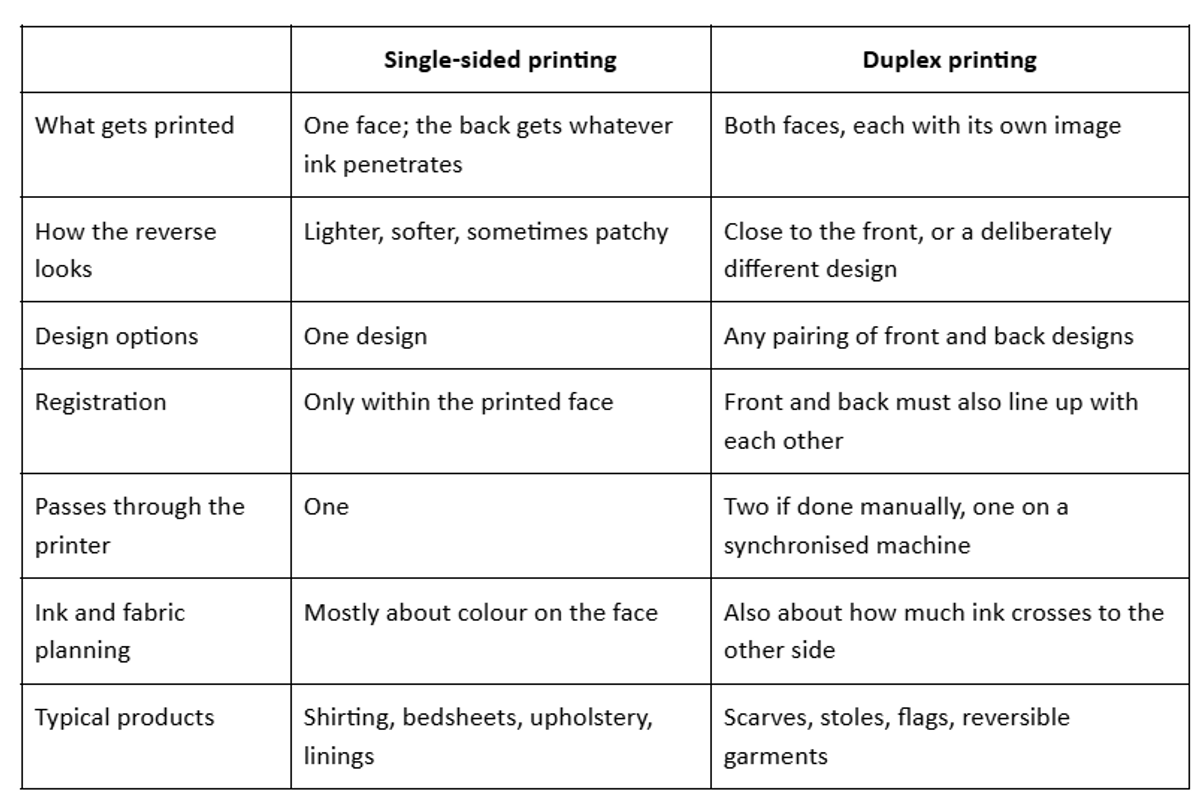
Single-sided vs duplex printing at a glance
What's the difference between manual and automatic duplex printing?
Office printers make this split easy to picture. With manual duplex printing, you print one side, flip the stack and feed it back in. Automatic duplex printing uses a built-in duplexer that turns the sheet for you. The idea carries over to fabric. The stakes don't.
Manual duplex on a textile line usually goes like this. You print the face, dry it, roll the fabric back up and load it again with the reverse facing the heads. Then the operator has to find the start of the design and line the second print up with the first by eye. Plenty of units turn out good two-sided fabric this way. Still, every step between the two prints gives the fabric a chance to stretch or skew, and the reverse side is exactly where that kind of drift becomes visible.
The trouble spots are predictable once you've watched a few rolls go through:
- The fabric has already been through one drying cycle, so its dimensions may have moved before the second side goes on.
- Rewinding and reloading add handling. Creases and edge curls show up as misregistration on the reverse, and so does any change in tension.
- The second side usually needs a mirrored file, and one wrong flip in the RIP means a whole roll printed back to front (a mistake most operators only make once).
- The printer is tied up for a second full run, which hurts most on short orders with many designs.
Automatic duplex printing on fabric needs a machine built for it. Printheads sit on both sides of the fabric path and work from one coordinated image file, so both faces are printed in the same pass. The roll never gets unloaded. Registration becomes a machine setting instead of an operator's judgement call, and drying is designed around fabric that's wet on both sides.
Our view is simple. Two-pass printing is fine for sampling or the occasional reversible order. Once two-sided fabric becomes a regular product line, though, the rewind-and-realign routine tends to cost more in rejected metres and lost machine time than it ever saves on equipment.
Why does the back of single-sided fabric look different?
Because the reverse only gets the ink that makes it through. That depends on the fabric's thickness and how open the weave or knit is, and also on the pretreatment and how heavily the printer lays ink down. On a thin silk or georgette, a single-sided print can look surprisingly decent from behind. A heavier cotton twill may stay almost plain.
True double-sided work runs into the same physics. A research on double-sided digital printing of silk chiffon found that the colour on each side often drifts away from the designed colour. The authors linked this to fabric thickness, gaps in the fabric structure and colourant penetration. Each face borrows from the other.
So sample on the real fabric. Check both faces in daylight, then adjust the file.
Single-sided printing is still the right call for most fabric
It might sound odd coming from a company that builds a duplex machine, but most printed fabric doesn't need a printed back. Shirting and kurta material are seen from one side. So are bedsheets and upholstery, and anything with a lining. Paying for a second image nobody looks at only adds cost.
If the reverse just has to look clean, the right ink with decent penetration usually handles it.
The deciding question is whether the end customer sees the back while actually using the product. If they'll only notice it when they flip the piece over in the shop, single-sided is probably enough. If it shows every time the fabric moves or hangs, you're in duplex territory.
Which products need double sided printing?
Anything that's looked at from both sides during use. Scarves, stoles and dupattas are the obvious cases, since they're draped and folded so that the reverse is on show for most of the time they're actually worn. Flags and hanging banners get viewed from either direction, as do fabric room dividers. Reversible jackets and wrap skirts sell on the promise of two looks in one piece.
There's a less obvious use as well. Digital duplex printing can recreate a yarn-dyed look, where a check or stripe shows through on both faces the way it would if the fabric had been woven from dyed yarn. For shirting brands that want short runs of yarn-dye style designs without setting up a loom, that's a genuinely new option.
How to print double sided on fabric
Whatever machine you use, settle these before the roll is loaded:
- Decide how the faces relate. Should the back match the front or mirror it? Or does it carry a design of its own?
- Prepare both artworks together, handle the mirroring in the RIP and mark a clear registration reference.
- Choose fabric and pretreatment with both faces in mind, because an absorbent base pushes more colour through.
- Print a test strip and check both faces in natural light, including where they overlap.
- Plan drying for two wet faces.
- Check registration at the start, middle and end of the roll, not just the first metre.
When Is Double-Sided Fabric Printing A Right Choice
If two-sided fabric is a regular production for you, MAS Vertical is solution. It uses a synchronised double-sided setup with dual-carriage Kyocera printheads, so both faces are printed in a single pass instead of two separate runs. Onboard image processing handles the front and back files together. Dual-zone drying deals with fabric that leaves the print zone wet on both sides, and the system also supports digital yarn-dye effect replication.
For mostly single-sided work, it's the wrong pick. A direct-to-fabric printer matched to your fabric range and volumes will serve you better there, and our guide to choosing a textile printing machine explains how to pick one. For the synchronised workflow explained step by step, read our piece on printing designs on both sides of fabric.
FAQs
Is duplex printing the same as double sided printing?
Yes. "Duplex" is the trade term and "double sided" is the everyday one.
Is duplex printing slower than single-sided printing?
Depends on how it's done. Doing it by hand means a second full run through the printer, with rewinding and realignment in between. A synchronised duplex machine prints both faces in one pass, so the gap shrinks a lot.
Can I make my single-sided textile printer print double-sided?
Only manually, by printing one face and reloading the fabric for the other. The printer itself doesn't change, which means the quality of your registration comes down to your operators and how stable the fabric stays between passes.
How do I print double sided on a normal office printer?
Open the print dialog and look for an option like "Print on both sides". If your printer supports automatic duplex printing, it'll turn the paper itself. If it doesn't, pick the manual option, print the first side, then flip the stack and feed it back the way the on-screen prompt shows.
Will a single-sided print look the same from the back?
On thin, open fabrics it can come close. On heavier ones, expect a lighter and less defined image.
Planning a reversible fabric range? Talk to the Orange O Tec team about whether single-sided or duplex printing suits your fabrics and order sizes.