
Back to Blogs
Industry
How to Choose the Right Digital Inks for Textile Printing
Choosing the right ink is one of the most important decisions in digital textile printing. A good print does not depend on the printer alone. The ink needs to work with the fabric, printing technology, colour requirements, and final application.
Orange O Tec
12 Nov 2026 • 5 min read
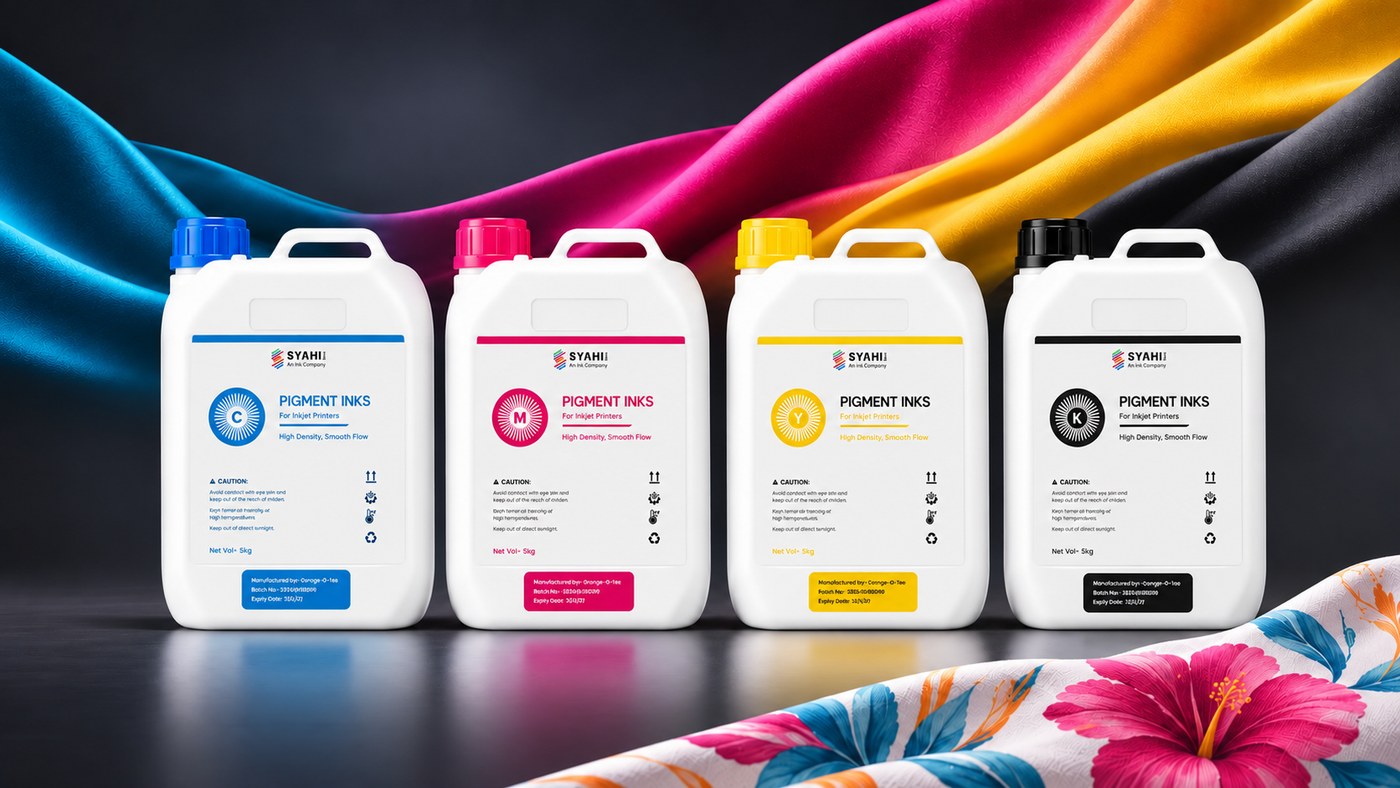
With the growing adoption of digital inks in textile manufacturing, there are more options available than ever. Reactive, pigment, sublimation, disperse, and acid inks are designed for different substrates and applications. Selecting the wrong one can affect colour reproduction, print quality, durability, production efficiency, and even the performance of the printing machine.
So, how do you choose the right digital printing ink?
The answer starts with understanding the relationship between the ink, fabric, printer, and end use.
What Are Digital Inks?
Digital inks are specially formulated inks used in inkjet-based digital printing systems. Unlike conventional printing processes that transfer colour through screens or other physical methods, digital printers deposit ink directly onto the printing surface based on a digital file.
In textile printing, the ink formulation needs to be compatible not only with the printer and printhead but also with the characteristics of the fabric.
This makes digital textile inks different from simply choosing a colour. Factors such as fabric composition, colour requirements, wash fastness, drying, fixation, and final application all need to be considered.
1. Start With the Fabric
The first question when selecting ink for digital printing should be: What fabric are you printing on?
Different fibres interact differently with different ink chemistries. An ink that works effectively on one substrate may not deliver the same results on another.
For example, reactive inks are commonly associated with cotton and other suitable natural fibres, while sublimation inks are used primarily for polyester-based applications. Pigment inks offer another route for textile printing across suitable substrates.
The fabric composition should therefore be one of the first things considered when selecting a fabric ink.
Before choosing an ink, identify:
- Fabric fibre and composition
- Woven or knitted construction
- Fabric weight and surface characteristics
- Whether the fabric has been pre-treated
- Required colour depth and appearance
- Intended end use
A clear understanding of the substrate makes it easier to narrow down the appropriate ink system.
2. Understand the Main Types of Textile Printing Ink
There is no single textile printing ink that is ideal for every application. Different ink technologies are designed around different fabric types and production requirements.
Reactive Ink
Reactive inks are used for printing on suitable natural and cellulosic fabrics, particularly cotton.
They can produce strong colours and detailed prints, making them suitable for fashion and textile applications where colour performance and fabric feel are important.
Reactive printing typically involves pre-treatment and post-printing processes such as washing and drying to achieve the desired result.
Pigment Ink
Pigment inks work differently because the colourant is deposited onto the surface of the textile rather than relying on the same type of fibre reaction associated with reactive dyes.
This can make pigment printing suitable for a wider range of textile substrates, depending on the formulation and application process.
Pigment systems can be particularly useful when flexibility across different fabrics is an important production requirement.
Sublimation Ink
Sublimation inks are primarily used for polyester and other suitable synthetic substrates.
During the sublimation process, the ink is transferred into the fabric through heat, creating a print that becomes part of the textile structure.
This makes sublimation a popular choice for applications where polyester-based fabrics are being used.
Your current ink portfolio includes Reactive, Pigment and Sublimation options, with fabric swatches specifically mapped to applications such as Reactive/Cotton, Pigment/Chemical Fibre and Sublimation/Polyester.
3. Check Printer and Printhead Compatibility
Even if an ink is suitable for a particular fabric, it still needs to be compatible with the printing equipment.
Printheads have specific requirements relating to viscosity, surface tension, particle size, and other ink properties. Using an incompatible ink can affect nozzle performance, print consistency, and machine reliability.
This is why compatibility should be checked between the:
Ink → Printhead → Printer → Fabric
A modern digital textile printing setup may use printheads from manufacturers such as Kyocera, Epson, Ricoh, or others, with different ink systems designed around those technologies.
For example, Position Pro is designed to work with reactive, acid, pigment, and high-energy dispersion inks and uses Kyocera industrial printheads.
The important point is that ink selection should be treated as part of the complete printing system rather than as an isolated purchase.
4. Look Beyond Colour
A common mistake is to judge high-quality inks primarily by how vibrant the colour looks immediately after printing.
Colour is important, but it is only one part of ink performance.
A suitable ink should also provide the characteristics required by the final application. Depending on the textile and use case, manufacturers may need to consider:
- Colour strength
- Colour gamut
- Shade consistency
- Wash fastness
- Print sharpness
- Fabric hand feel
- Storage stability
- Drying and fixation behaviour
- Compatibility with the printing system
For example, Syahi's ink content highlights wash-fastness testing as part of its quality evaluation, including a before-and-after wash sequence to demonstrate colour retention.
The best fabric printing ink is therefore not necessarily the one that produces the brightest first impression. It is the one that consistently meets the performance requirements of the finished textile.
5. Consider the Final Application
Where the printed fabric will ultimately be used should influence your ink selection.
A fashion fabric may have different requirements from sportswear, home décor, signage, or other textile applications.
What will happen to the fabric after printing?
Will it be washed frequently? Exposed to sunlight? Stretched? Used indoors? Converted into a garment? Sold as a premium textile?
These questions help determine the performance characteristics required from the ink.
For example, a textile intended for regular washing needs appropriate colour durability. A polyester sportswear application may call for a different ink system than a cotton fashion fabric.
The end use should always be part of the decision-making process.
6. Evaluate Colour Consistency
Colour consistency becomes increasingly important as production volumes increase.
A sample may look excellent, but the real test is whether the same colour can be reproduced consistently across multiple rolls, production runs, and machines.
This makes colour management an important part of the digital printing workflow.
RIP software, ICC profiling, printer calibration, ink formulation, printhead condition, and fabric characteristics can all influence the final colour.
Choosing reliable digital textile inks is therefore only one part of maintaining consistent colour. The ink needs to work within a controlled production environment.
7. Don't Ignore Ink Stability
Ink stability is another factor that can be overlooked when comparing fabric ink options.
An ink needs to remain stable during storage and production. Changes in ink behaviour can affect nozzle performance, colour consistency, and print quality.
This is particularly important in industrial environments where printers may operate for long production cycles.
Ink supply systems, degassing, filtration, and appropriate machine maintenance can also contribute to stable printing performance.
The objective is not simply to find an ink that works during a test print, but one that performs reliably throughout production.
8. Compare Total Printing Performance, Not Just Ink Price
Price per kilogram or litre is an easy number to compare, but it does not always tell you the actual cost of printing.
A lower-priced digital printing ink may not necessarily result in a lower overall production cost if it requires higher consumption or creates more production issues.
Instead, manufacturers should consider:
Ink price + ink consumption + reprints + maintenance + production downtime + finishing requirements
This gives a more realistic picture of ink economics.
An ink that costs slightly more but provides better consistency, controlled consumption, and reliable machine performance may have a different overall cost profile from a cheaper alternative.
9. Consider Environmental and Compliance Requirements
Environmental considerations are becoming increasingly relevant when selecting digital inks.
Manufacturers should look at the formulation, applicable certifications, chemical requirements, wastewater considerations, and compliance standards relevant to their market and end product.
The specific requirements can vary depending on the fabric, application, geography, and customer expectations.
For manufacturers supplying global textile brands, compliance requirements can become an important part of the ink-selection process rather than an afterthought.
10. Test Before Scaling Production
Even when an ink appears technically suitable, testing remains important.
Before moving into full-scale production, test the ink on the actual fabric and evaluate the finished result.
A practical testing process can include:
- Print on the target fabric.
- Check colour reproduction and detail.
- Evaluate ink penetration or surface appearance.
- Complete the required drying, curing, washing, or fixation process.
- Test relevant durability requirements.
- Compare the output against the approved sample.
- Run the ink through the intended printer and production conditions.
This helps identify issues that may not be visible during a simple laboratory or sample print.
A Simple Checklist for Choosing Digital Inks
Before selecting a fabric printing ink, manufacturers can use this checklist:
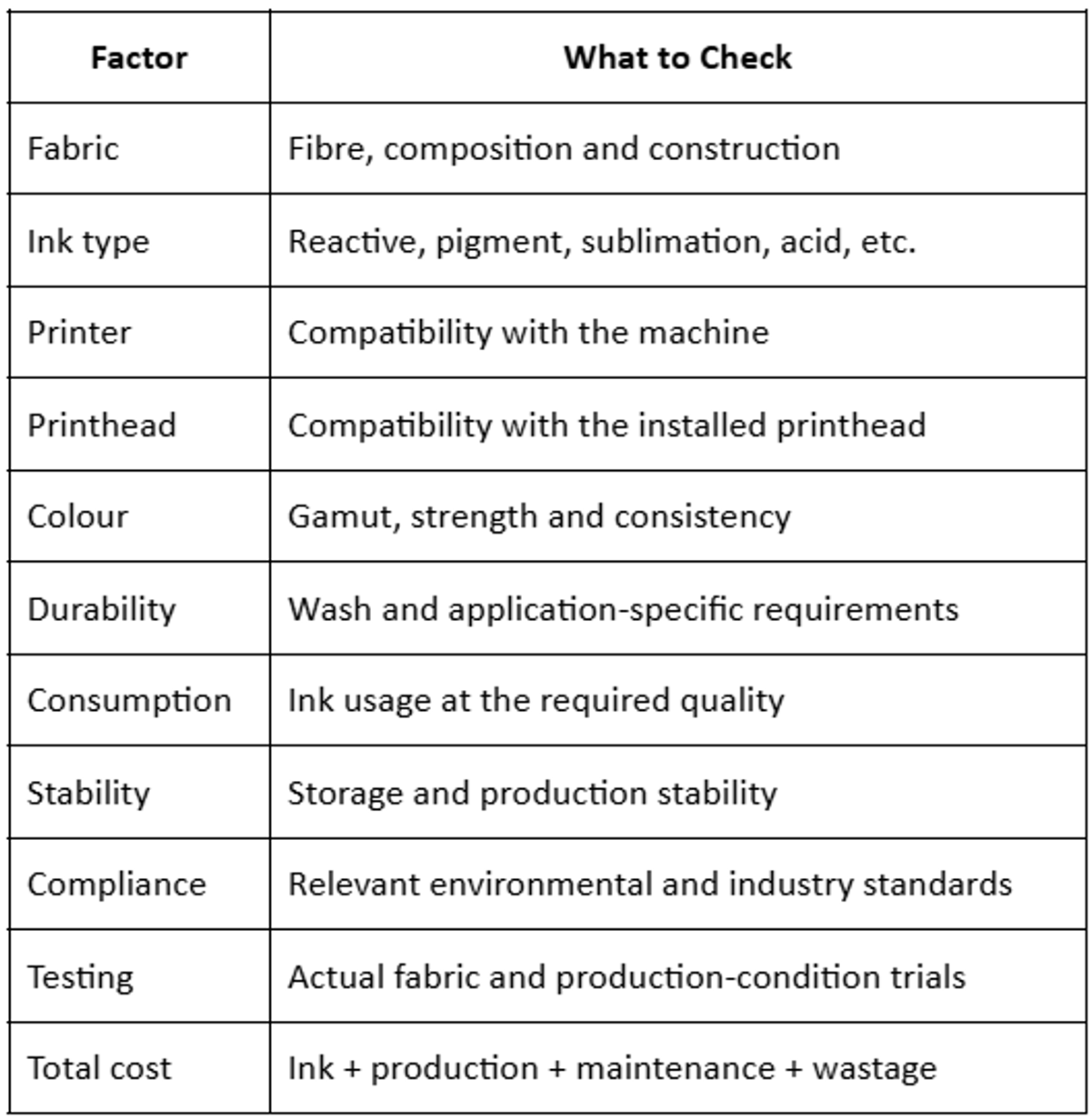
This approach makes the decision more systematic and reduces the risk of choosing an ink based on a single factor.
Choosing the Right Digital Ink Is a System Decision
The right ink for digital printing is rarely determined by the ink alone.
The best choice comes from looking at the entire printing system: the fabric, printer, printhead, artwork, production process, finishing requirements, and final application.
As digital textile printing continues to develop, ink technology will continue to play an important role in improving colour reproduction, consistency, efficiency, and application flexibility.
For manufacturers, the goal should not simply be to find high quality inks. It should be to find an ink system that performs predictably within their specific production environment.
Digital Textile Inks by Syahi
Syahi offers textile ink solutions across Reactive, Pigment, and Sublimation categories, designed around different fabric and application requirements. The portfolio is supported by a focus on consistency, testing, and compatibility with digital textile printing workflows.
For manufacturers evaluating digital textile inks, understanding the relationship between ink chemistry, fabric, printhead, machine, and final application is the first step toward making the right choice.
Conclusion
Choosing the right digital inks is an important part of building a reliable digital textile printing process.
The decision should begin with the fabric and end application, then move through printer and printhead compatibility, colour requirements, durability, stability, consumption, compliance, and real-world testing.
There is no universal fabric ink that works for every textile application. Different fabrics and production requirements call for different ink technologies.
By treating ink selection as a complete system decision rather than simply a price or colour decision, textile manufacturers can build a more consistent and predictable printing workflow—and get more value from their digital printing investment.