
Back to Blogs
Products
How Position Printing Improves Print Accuracy and Reduces Fabric Waste
In textile printing, accuracy is not simply about producing a sharp image. It is about making sure the design lands exactly where it is intended on the fabric, especially when working with embroidery, jacquard, lace, and other structured textiles.
Orange O Tec
10 Sept 2026 • 5 min read
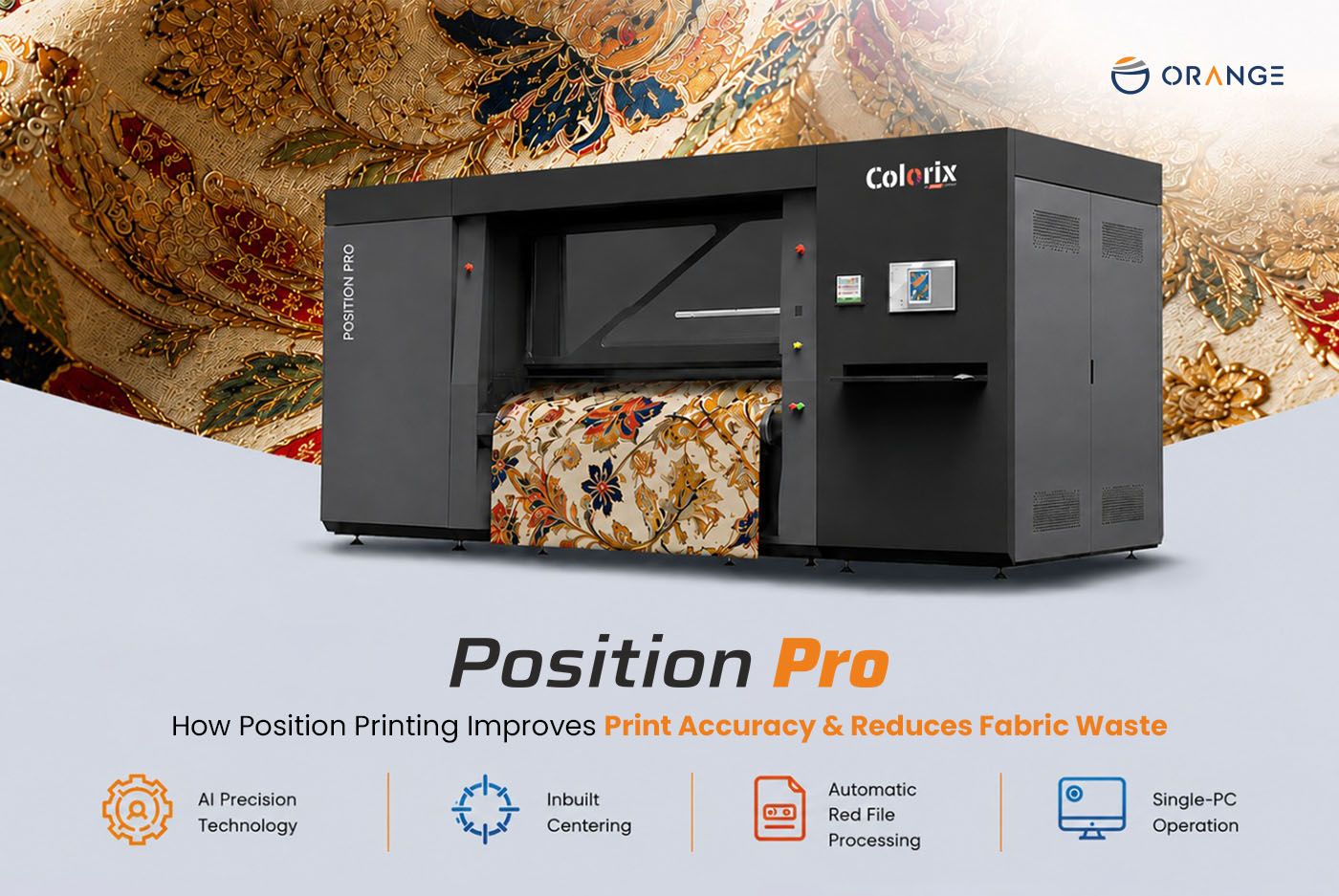
Even a small shift in positioning can affect the final appearance of a garment or textile product. It can lead to misaligned motifs, uneven placement, reprints, and unnecessary fabric waste. As textile manufacturers handle increasingly customized orders and shorter production runs, controlling these errors becomes an important part of maintaining both quality and production efficiency.
This is where position printing plays an important role.
By combining precise fabric alignment, digital positioning, automated file processing, and vision-based systems, position printing machines can help manufacturers achieve greater print accuracy while reducing the amount of material lost due to positioning errors.
What Is Position Printing?
Position printing is a digital textile printing process designed to place a design accurately at a specific location on the fabric.
Unlike conventional all-over printing, where the design is continuously repeated across the fabric, position printing is used when the location of the print matters. This makes it particularly useful for applications such as embroidery, jacquard, lace, and other fabrics where the design needs to align with an existing pattern or construction.
The process depends on more than just the printer. Fabric feeding, alignment, file preparation, registration, and printhead control all contribute to the final result.
A modern position printing machine therefore combines digital printing technology with systems that help control the position of both the fabric and the artwork throughout production.
Why Print Position Matters in Textile Manufacturing
In textile production, a design can be technically well printed and still be considered defective if it is positioned incorrectly.
For example, a motif intended to sit within an embroidered section may overlap the embroidery if the fabric shifts during printing. Similarly, a design printed on jacquard or lace needs to follow the intended structure of the material.
These errors can have several consequences:
- Reprinting of incorrectly positioned fabric
- Increased fabric waste
- Additional ink and energy consumption
- Longer production cycles
- More manual intervention
- Inconsistent output between pieces
This makes print accuracy an important production consideration, particularly for customized and high-value textile applications.
How Position Printing Improves Print Accuracy
1. Precise Fabric Alignment
One of the biggest factors affecting print accuracy is how consistently the fabric is positioned before and during printing.
An integrated centering or alignment system can help maintain the correct fabric position without relying entirely on manual adjustments. This reduces the possibility of the design shifting away from its intended location.
For example, Position Pro incorporates an inbuilt centering unit designed to ensure fabric alignment for precision printing.
Better alignment means the printer has a more reliable reference point from which to reproduce the design.
2. Digital Positioning Reduces Manual Errors
Traditional manual positioning can introduce variation between operators and production runs.
Digital positioning helps move this process toward a more controlled workflow. Instead of relying solely on visual judgement, digital systems can use predefined files, positioning information, and automated controls to reproduce the intended placement more consistently.
This is particularly useful when the same design needs to be reproduced across multiple pieces or when working with intricate textile structures.
The goal is not simply faster printing. It is repeatable precision printing.
3. Vision Systems Help Identify the Correct Printing Position
Modern position printing equipment can incorporate industrial vision systems to support precise positioning.
Position Pro, for instance, uses an integrated high-precision industrial vision system designed for positioning and printing applications, including jacquard, embroidery, lace, and double-sided printing.
Vision-based technology can provide an additional layer of control by helping the printing system identify and maintain the intended relationship between the fabric and the digital design.
This becomes especially valuable when the substrate itself contains patterns, textures, or structures that need to be considered during printing.
4. Automated File Processing Supports Consistency
Print accuracy begins before the fabric reaches the printhead.
Incorrect file preparation, manual adjustments, or inconsistent settings can create errors during production. Automated file-processing systems can reduce some of this manual intervention by preparing print files according to predefined requirements.
Position Pro's Red File Automation System, for example, automatically processes and prepares print files for production. According to its specifications, point files can be prepared in approximately 15–20 minutes compared with workflows that may take up to two hours.
Reducing manual preparation can also help minimize operator-related errors, particularly in repetitive production environments.
How Better Positioning Helps Reduce Fabric Waste
Fabric waste is often discussed in terms of cutting and material utilization, but printing errors can also contribute significantly to material loss.
When a design is printed in the wrong position, the affected fabric may need to be reprinted or rejected. The more complex or expensive the fabric, the greater the impact of that error.
Position printing can reduce this risk by improving control over three key areas:
Alignment: Keeping the fabric correctly positioned helps prevent designs from drifting away from their intended location.
File accuracy: Automated file preparation can reduce errors before printing begins.
Repeatability: Consistent positioning makes it easier to reproduce the same design placement across multiple production runs.
These improvements do not eliminate fabric waste completely. Fabric characteristics, feeding conditions, operator practices, file quality, and machine settings can all influence waste. However, better control over positioning can reduce waste caused specifically by print-placement errors.
Position Printing vs. Conventional Digital Textile Printing
Both conventional digital textile printing and position printing offer advantages, but they serve different production requirements.
All-over digital printing is generally designed to reproduce a continuous pattern across the fabric. Position printing, on the other hand, is focused on where the design needs to appear.
This distinction becomes important when producing:
- Embroidery-based textiles
- Jacquard fabrics
- Lace
- Structured or patterned fabrics
- Customized garment panels
- Designs requiring specific placement
For these applications, print accuracy can be just as important as resolution or color reproduction.
What to Look for in a Position Printing Machine
When evaluating a position printing machine, manufacturers should look beyond headline production speed. The positioning and control systems can have a direct impact on print quality and material utilization.
Important capabilities to consider include:
Fabric alignment
An integrated centering system can help maintain consistent fabric positioning and reduce manual adjustments.
Vision-based positioning
A high-precision vision system can support accurate registration, particularly for structured textiles.
Automated file processing
Automation can reduce preparation time and minimize errors associated with repetitive manual file handling.
Stable fabric feeding
Consistent fabric movement is essential for maintaining accurate placement throughout the print.
Printhead control
Industrial printheads and appropriate control systems help maintain consistent ink deposition and image quality.
Software and color management
RIP software plays an important role in translating artwork into accurate, production-ready print files. Position Pro integrates NeoStampa for RIP and color management.
The Bigger Role of Precision Printing in Textile Production
The value of precision printing goes beyond producing visually accurate designs.
When positioning becomes more predictable, manufacturers can potentially reduce rework, improve material utilization, simplify operator intervention, and maintain greater consistency between production batches.
This becomes increasingly relevant as textile manufacturers move toward customized designs, shorter production runs, and more complex fabric applications.
Position printing does not replace the importance of good fabric preparation, accurate artwork, skilled operators, or proper machine maintenance. Instead, it brings these elements together through a more controlled digital workflow.
Position Pro by Orange O Tec
For textile manufacturers looking to implement position printing, Orange O Tec offers the Position Pro, a high-speed positioning digital textile printer designed for applications such as embroidery, jacquard, lace, and other structured fabrics.
Position Pro focuses not just on printing faster, but on maintaining consistent positioning and reducing errors that can contribute to reprints and fabric waste. It supports a range of textile applications and ink types, including reactive, acid, pigment, and high-energy dispersion inks.
For manufacturers exploring precision printing and digital positioning for structured textile applications, Position Pro is one solution designed around these specific production requirements.
Conclusion
For textile manufacturers, print accuracy is closely connected to production efficiency. A design that is printed beautifully but positioned incorrectly can still result in rejected fabric, rework, and unnecessary material consumption.
Position printing addresses this challenge by combining accurate fabric alignment, digital positioning, vision-based systems, automated file preparation, and controlled printing processes.
For applications such as embroidery, jacquard, and lace, where design placement is critical, these capabilities can make a meaningful difference. The result is a more predictable printing process with greater control over placement and the potential to reduce fabric waste caused by positioning errors.
As digital textile printing continues to evolve, precision will increasingly be measured not only by how well a printer reproduces a design, but also by how accurately and consistently it places that design where it belongs.