
Back to Blogs
Industry
Digital Textile Printing in 2026: The Future of Sustainable Fabric Printing
The textile industry is under increasing pressure to produce more efficiently while responding to changing customer demands, shorter production cycles, and growing expectations around resource consumption. As these demands evolve, digital textile printing is becoming an increasingly important part of the modern textile manufacturing landscape.
Orange O Tec
15 Sept 2026 • 5 min read
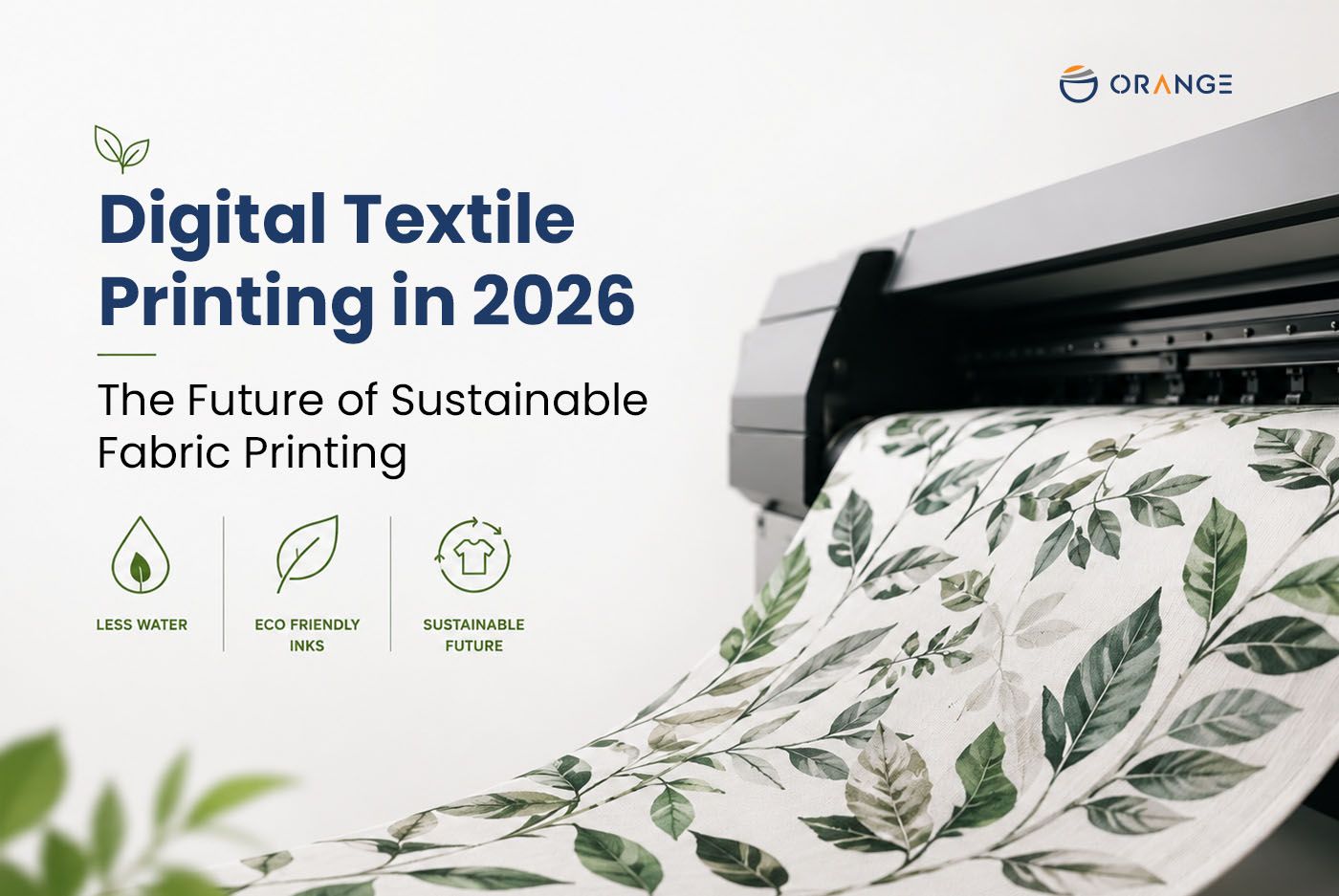
Unlike traditional textile printing methods that often require extensive setup, screens, plates, and longer production runs, digital printing allows designs to be transferred directly from digital files onto fabric. This makes it easier to produce customized designs, shorter runs, and on-demand orders while reducing some of the resources associated with conventional printing processes.
In 2026, the conversation around digital textile printing is moving beyond speed and design flexibility. The focus is increasingly on how printing technology can help manufacturers improve resource efficiency, reduce waste, and build more adaptable production systems.
What Is Digital Textile Printing?
Digital textile printing is a process in which digital artwork is printed directly onto fabric using specialized inkjet printing technology.
Instead of creating physical screens or plates for every design, the artwork is prepared digitally and sent to a digital textile printing machine, which deposits ink onto the textile according to the digital file.
This approach provides greater flexibility for manufacturers producing different designs, colors, patterns, and quantities.
It is particularly useful for applications where customization and shorter production runs are important. From fashion and home décor to specialized textile applications, digital printing can support a wider variety of designs without requiring the same physical setup associated with conventional printing.
Why Sustainability Is Becoming Important in Textile Printing
Sustainability in textile manufacturing is not limited to the choice of fabric or ink. The production process itself can influence how much material, ink, energy, and time are consumed.
A printing process that requires large quantities of setup material or produces significant amounts of rejected fabric can increase overall resource consumption.
This is where modern textile printing technology can make a difference.
Digital systems can provide manufacturers with greater control over the production process, particularly when producing smaller quantities or multiple designs. By reducing the need for physical setup and allowing files to be changed digitally, manufacturers can adapt production more easily to actual order requirements.
However, digital printing should not automatically be considered sustainable simply because it is digital. Its environmental impact depends on the inks used, equipment, energy consumption, fabric preparation, drying processes, production volumes, and overall workflow.
The opportunity lies in using textile printing technology to make production more controlled and resource-efficient.
1. Less Material Waste Through On-Demand Production
One of the major advantages of digital fabric printing is the ability to produce smaller quantities without requiring the same level of setup as traditional processes.
This is particularly relevant as brands and manufacturers move toward more customized collections and shorter production runs.
Instead of producing large quantities based on forecasts, digital printing can make smaller-batch production more practical. This can help manufacturers respond to actual demand and reduce the risk of excess printed inventory.
When fewer unwanted designs need to be produced, there is potential to reduce material waste associated with overproduction.
2. More Efficient Ink Usage
Ink efficiency is another area where advances in digital printing technology can contribute to more efficient production.
Modern RIP software and printer control systems can optimize how digital files are processed and how ink is applied to the fabric. Better color management and controlled ink deposition can help achieve the required result without unnecessarily increasing ink consumption.
For example, the NeoStampa workflow used with Position Pro highlights optimized ink efficiency as one of its capabilities, with the aim of reducing ink consumption without compromising print quality.
The significance of this extends beyond cost. Using only the required amount of ink can contribute to more efficient use of production resources.
3. Digital Workflows Reduce Physical Setup Requirements
Traditional textile printing can involve physical screens, plates, and other preparation processes. Every new design can require additional setup, which becomes less practical when manufacturers are handling numerous designs or small orders.
With digital textile printing, the design exists as a digital file and can be prepared for printing without creating a new physical screen for every design.
This makes the workflow more adaptable.
A manufacturer can move from one design to another by changing the digital file rather than rebuilding the physical setup. For businesses handling customized orders, this can reduce preparation requirements and make short production runs more practical.
4. Precision Can Help Reduce Reprints
Sustainability is also connected to what happens when something goes wrong during production.
A misaligned design, inconsistent color, or printing error can result in rejected fabric that needs to be reprinted. The original material, ink, energy, and production time have already been consumed.
Modern digital fabric printing machines increasingly use automated systems to improve consistency and reduce human intervention.
Position Pro, for example, combines automated file processing with an inbuilt centering unit designed to maintain fabric alignment and reduce print shifting and waste.
Better control does not eliminate production waste, but it can help reduce waste associated with preventable printing errors.
5. Automation Is Changing Modern Textile Printing
Another major development in modern textile printing is the growing role of automation.
Automation is being introduced across different stages of the workflow, from file preparation and color management to fabric feeding, cleaning, and machine operation.
This is important because production efficiency is not determined by printing speed alone. Time spent preparing files, adjusting the machine, changing jobs, or correcting errors can also affect overall resource consumption.
Position Pro's Red File Automation System, for example, automatically processes and prepares print files for production. Its specifications state that point files can be prepared in approximately 15–20 minutes, compared with workflows that may take up to two hours.
Faster preparation can help reduce idle production time and make shorter production cycles easier to manage.
6. Shorter Production Runs Are Becoming More Practical
Consumer demand is changing the way textile manufacturers approach production.
Instead of relying exclusively on large-volume production, businesses increasingly need to accommodate customized designs, limited collections, sampling, and smaller orders.
This is one area where digital fabric printing has a natural advantage.
Because designs can be changed digitally, manufacturers can move between different designs without the same physical setup associated with conventional printing. This flexibility makes digital printing suitable for businesses that need to produce multiple designs in smaller quantities.
The result is a production model that can respond more closely to demand rather than relying exclusively on large predetermined runs.
7. Digital Printing Technology Is Becoming More Versatile
Another important trend in textile printing technology is the ability to work across a wider range of fabrics and ink systems.
Modern digital textile printers can be configured for different applications and textile substrates. Position Pro, for example, supports cotton, linen, silk, nylon, polyester, blends, elastic fabrics, and other woven and knitted fabrics. It is also designed for applications including lace, embroidery, and jacquard.
The printer supports reactive, acid, pigment, and high-energy dispersion inks, allowing the same platform to address different textile printing requirements.
This flexibility is important as textile manufacturers look for production systems that can handle increasingly varied customer requirements.
What Will Define Sustainable Digital Textile Printing in the Future?
The future of sustainable textile production is unlikely to depend on one machine, one ink, or one printing process.
Instead, it will involve improvements across the entire production workflow.
For digital textile printing, some of the key areas to watch include:
- More efficient ink deposition and consumption
- Better color management and repeatability
- Reduced material waste from printing errors
- Greater automation of production workflows
- More efficient use of energy and machine capacity
- Increased adoption of on-demand and short-run production
- Better compatibility with different fabrics and ink technologies
- Improved monitoring of production and resource consumption
The technology itself will continue to evolve, but how manufacturers integrate it into their production processes will be equally important.
Choosing a Digital Textile Printing Machine
For manufacturers considering a fabric printing machine, sustainability should be evaluated alongside productivity, print quality, reliability, and total operating requirements.
Instead of looking only at maximum printing speed, it is worth considering how efficiently the complete workflow operates.
Questions such as these can help:
- How much ink is consumed for the required print quality?
- How much fabric is lost due to alignment or printing errors?
- How quickly can the machine move between different designs?
- How much manual intervention is required?
- How efficiently are print files prepared?
- What fabrics and ink types can the machine support?
- How are cleaning, maintenance, and ink management handled?
- What are the machine's energy and drying requirements?
Looking at the complete workflow gives manufacturers a better understanding of the actual efficiency of a digital textile printing machine, rather than judging it by speed alone.
Digital Textile Printing and the Future of Fabric Manufacturing
The future of textile printing will likely be defined by a combination of flexibility, precision, automation, and resource efficiency.
Digital printing is already changing how manufacturers approach customized production and shorter runs. As the technology develops further, improvements in ink efficiency, automation, file processing, color management, and machine control can make the production process increasingly efficient.
The important shift is that sustainability is becoming part of the broader production equation. It is no longer only about what material is being printed; it is also about how efficiently that material is converted into a finished product.
For manufacturers, digital textile printing offers an opportunity to build a more adaptable production workflow—one that can respond to changing demand while maintaining control over quality, productivity, and resource utilization.
Exploring Digital Textile Printing with Orange O Tec
Orange O Tec works with digital textile printing solutions for manufacturers looking to adopt advanced printing technology, including the Position Pro, a high-speed positioning printer designed for precision textile applications. Its combination of automated file processing, fabric centering, ink-efficiency features, and digital workflow controls reflects how modern printing systems are moving toward more efficient production.
Conclusion
Digital textile printing is becoming an increasingly important technology for a textile industry that needs greater flexibility without losing control over production efficiency.
Its ability to support shorter runs, digital workflows, automated file preparation, precise printing, and more controlled ink usage makes it a strong fit for the evolving needs of textile manufacturing.
But the future of sustainable fabric printing will not come from technology alone. Manufacturers will need to look at the entire production process—from artwork preparation and fabric handling to ink usage, machine efficiency, and waste management.
As digital fabric printing and textile printing technology continue to develop, the businesses that use these technologies thoughtfully will be better positioned to produce with greater precision, flexibility, and efficiency.