
Back to Blogs
Industry
Current Trends in the Digital Printing Industry: What's Reshaping How the World Prints
Explore the top digital printing industry trends of 2026 — from AI automation and sustainable inks to textile printing growth and variable data personalisation.
Orange O Tec
12 Aug 2026 • 5 min read
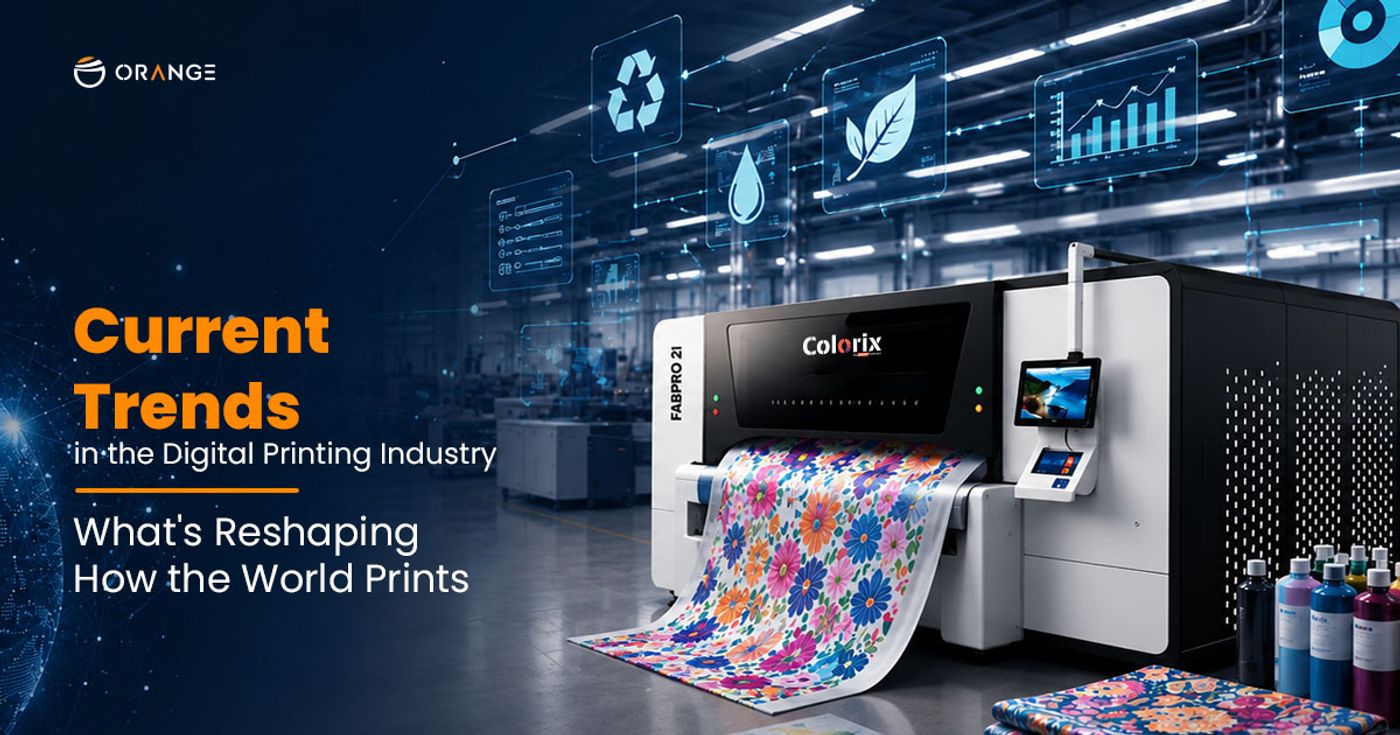
The global digital printing market is no longer growing — it is accelerating. From USD 33.4 billion in 2025, the industry is on track to cross USD 63 billion by 2035. That is not incremental improvement. That is a structural transformation.
And yet, many businesses — textile manufacturers, packaging units, label producers, commercial printers — are still running on assumptions that made sense five years ago. Same machines. Same inks. Same workflows. While the market moves, they stand still.
This article breaks down the most important trends shaping the digital printing industry in 2026: what is driving them, what they mean for your business, and where the real opportunities lie — especially in India's fast-maturing manufacturing ecosystem.
1. AI and Automation Are Rewriting Production Economics
Artificial intelligence has moved from pilot projects into production floors. In 2026, AI-powered print automation is not a competitive advantage — it is rapidly becoming the cost of staying competitive.
On the machine side, AI handles colour correction, substrate detection, and predictive maintenance — catching printhead degradation before it causes a full production stoppage. On the workflow side, AI-driven scheduling tools are cutting job setup time by 30–40% for commercial printers managing high-SKU environments.
For textile and packaging businesses, the downstream impact is significant. AI enables smarter sampling, faster proofing, and real-time production analytics. Businesses that integrate these tools into their daily operations are reporting lower waste, tighter margins control, and faster turnaround for buyers — three things that matter most when you are competing on quality and speed, not just price.
The printing businesses that will struggle in the next five years are not the ones without the biggest machines — they are the ones running smart machines on dumb workflows.
2. Sustainability Has Shifted from Brand Story to Buyer Mandate
Two years ago, sustainability was a marketing differentiator. Today, it is a procurement condition.
European and North American retail buyers — particularly in apparel, home textiles, and packaging — are enforcing strict environmental standards across their vendor base. OEKO-TEX® certification, GOTS compliance, and measurable reductions in effluent load are now table-stakes requirements for export-oriented manufacturers.
Digital textile printing directly addresses this pressure. Compared to traditional screen printing, digital processes use up to 90% less water, eliminate the chemical-heavy plate-making stage, and produce dramatically less effluent. Water-based, reactive, and pigment inks are replacing solvent systems across production lines.
Syahi — Orange O Tec's in-house ink brand — is OEKO-TEX® certified and engineered for reactive, pigment, and sublimation applications. For manufacturers positioning their facilities for export compliance, ink traceability and certification are no longer optional. They are documented on every buyer audit checklist.
The business case for sustainable printing is not ideological. It is practical: it opens doors that closed-loop chemical printing keeps shut.
3. Digital Textile Printing Is Entering Its Industrial Phase in India
India has always been a textile powerhouse. But in 2026, something is shifting. The country is no longer just producing fabric — it is producing design. And digital printing is the technology making that possible at scale.
The Asia-Pacific region is the fastest-growing segment of the global digital printing market, driven by manufacturing expansion, packaging demand, and rapid industrialisation in India and China. Within India, the textile clusters of Surat, Jaipur, Tirupur, and Ludhiana are seeing meaningful upgrades from conventional screen printing to high-speed digital systems.
The driving forces are clear:
- Buyers demanding faster sampling and shorter lead times
- Shrinking MOQs requiring short-run production capability
- Rising labour costs making automated digital workflows attractive
- Government PLI scheme incentives encouraging domestic manufacturing upgrades
Orange O Tec's Colorix FabPro line — Made in India, for Indian manufacturing conditions — is purpose-built for this transition. The FabPro 1i produces 2,200 LM/day. The FabPro 2i runs at 5,500 LM/day. Both carry Ricoh printheads and a modular architecture that lets businesses scale output as order books grow — without replacing the entire machine.
750+ installations and 85+ service engineers across India is not just a statistic. It is the difference between a machine that runs and a machine that keeps running.
4. Personalisation and Variable Data Printing Are Redefining Print Value
Print-on-demand is not a niche anymore. It is a mainstream fulfilment model — and variable data printing (VDP) is the engine behind it.
VDP technology allows printers to personalise every single unit in a run without stopping production — different name, different image, different QR code, same print speed. For pharma label producers, FMCG packaging companies, and direct-mail marketers, this is not a gimmick. It is a conversion tool. Studies consistently show personalised print delivers 3–5x higher response rates than generic equivalents.
The commercial printing market is also feeling the pressure from shorter runs. Analog offset printing struggles to compete below 5,000 units — plate costs, washup times, and make-ready waste make economics unfavourable for small jobs. Digital printing, particularly with today's inkjet systems, now matches offset economics for runs of 2,000–10,000 sheets, while delivering customisation that offset simply cannot.
For label and packaging businesses, JetRix digital label printers from Orange O Tec run at up to 50 metres per minute — purpose-built for the pharma, FMCG, and cosmetics sectors where compliance, variability, and speed all need to co-exist on the same production line.
5. Web-to-Print Technology Is Compressing the Buyer Journey
The way buyers order print is changing fundamentally. Web-to-print (W2P) platforms allow customers to upload artwork, configure specifications, approve proofs, and place orders — without a single phone call. For printing businesses still relying on manual quoting and back-and-forth email approvals, the operational gap is widening fast.
W2P adoption is accelerating across commercial print, apparel decoration, and promotional products. The businesses benefiting most are those that have paired W2P front-ends with high-speed digital print backends — so that when an order lands, production starts immediately rather than waiting for plate setup or screen preparation.
For manufacturers investing in digital print infrastructure, W2P integration is the logical next step. It turns a production asset into a sales channel — running 24 hours, taking orders without a sales team, and feeding jobs directly into the print queue.
6. Inkjet Dominates — and the Technology Gap Between Printheads Is Widening
Inkjet printing continues to lead the digital printing market, holding over 39% market share by technology type — and the gap is growing. The reasons are straightforward: inkjet is substrate-agnostic, compatible with a widening range of ink chemistries, and increasingly capable of industrial-grade speeds.
But not all inkjet is equal. The printhead is the heart of any digital textile printer — and printhead selection determines your uptime, colour consistency, and total cost of ownership. Kyocera printheads are recognised for their industrial durability and precision. Epson I3200 printheads deliver speed and fine-detail reproduction at lower production costs.
Orange O Tec has installed over 10,000 Kyocera and 5,000 Epson I3200 printheads across its customer base. That installation depth reflects real operational expertise — not just hardware sales. It means the service team already knows how your machine behaves, what failure patterns look like, and what to do before production stops.
For businesses evaluating their next machine, the question is not simply which brand. It is which printhead architecture best matches your ink chemistry, your substrate mix, and your production hours per day.
Conclusion
The digital printing industry is not waiting. It is consolidating around businesses that have made the right technology decisions — and separating from those that have not. The trends covered in this article — AI automation, sustainability compliance, Indian textile digitalisation, personalisation at scale, web-to-print integration, and inkjet advancement — are not future forecasts. They are present-tense market pressures.
The manufacturers who are winning today made investments 18–24 months ago that their competitors dismissed as premature. The businesses who will win in 2027 are making those investments right now.
Because the future of printing isn't just digital — it's decisive.
Ready to understand which digital printing technology fits your production goals?